Worlds in Motion: How Lap-See Lam is Redefining the Gesamtkunstwerk for the 21st Century
Visitors can hear Lap-See Lam’s exhibition the moment they step through The Power Plant’s doors. Her 2024 video installation Floating Sea Palace fills the gallery with a forceful tide of sound that the building itself, not designed to channel such sound, can barely contain.

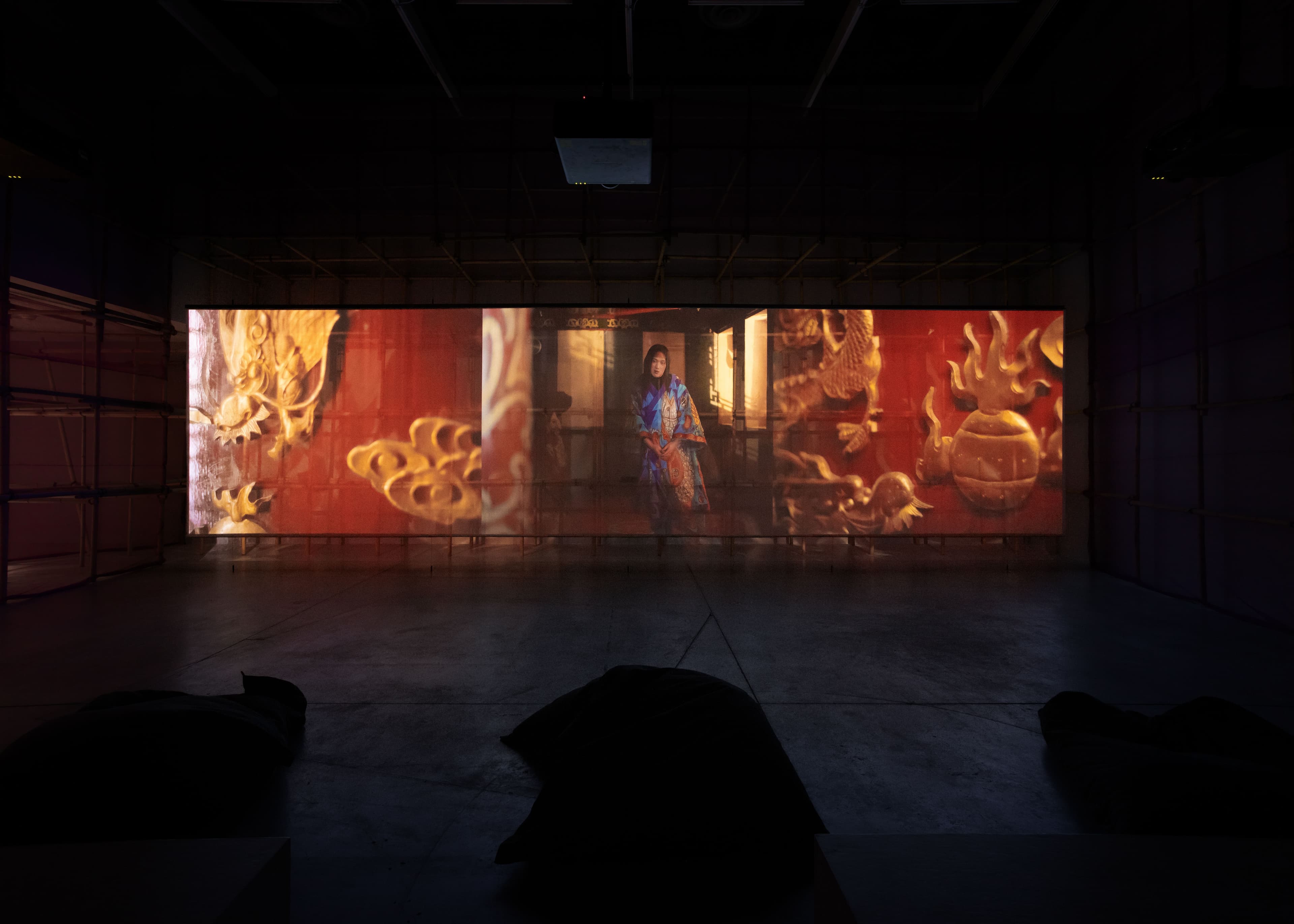
Lap-See Lam, Floating Sea Palace, 2024. Organized and developed in partnership with The Vega Foundation. Installation view: The Power Plant, Toronto, 2024. Photo: LF Documentation.
Floating Sea Palace tells the story of Lo Ting, a mythical half-human, half-fish figure said to be an ancestor of the Hong Kong people. (Ngai) Within the film’s fragmented temporal framework, Future Lo Ting, the protagonist, recounts how his past self was lured from his underwater home by a handsome fisherman. Regretting this choice, Future Lo Ting spends his time trying to prevent his past self from repeating the same mistake. His desperation summons another lost soul: a three-story dragon ship, and the titular Floating Sea Palace. Far from mythological, the ship was inspired by a real vessel originally conceived as a floating Chinese restaurant. Built in Shanghai in the 1990s, it sailed to Gothenburg where, despite its grandeur, the business quickly failed. Since then, it has traveled to various Nordic harbours as a tourist attraction. (The Power Plant)
Lam, who was born in Stockholm to Cantonese parents, first encountered the ship as an art student when it was being used as a haunted house attraction in a Stockholm theme park. In the film’s narrative, Lo Ting boards the ship which is personified as “the Dragon” and played by Swedish singer Sofia Jernberg. Together with another character, the Singing Chef (voiced by Lam’s father), they drift across the sea in search of a home they may never find.
Renowned for her lush multimedia installations and fantastical narratives, Lam explores the histories of the Cantonese diaspora in both her native Sweden and across the world. Floating Sea Palace extends this ongoing inquiry through an ambitious 30+ minute film housed within a large-scale bamboo scaffold, a reference to the traditional Cantonese bamboo opera house. (Duhalde, Tian, Wong) By merging new media such as 3D architectural scans, VR, and animation with historical Chinese artforms like shadow puppetry and bamboo architecture, Lam continues to refine her distinctive approach to collaborative, cross-disciplinary artmaking.

Lap-See Lam, Floating Sea Palace, 2024. Organized and developed in partnership with The Vega Foundation. Installation view: The Power Plant, Toronto, 2024. Photo: LF Documentation.
This synthesis of forms reflects the ideal of the Gesamtkunstwerk, a German term meaning “total work of art,” which unites multiple artistic disciplines into a single, cohesive experience. Opera is often cited as the most complete expression of this idea, blending music, text, stage design, and performance. (The Art Story) Two of its most significant theorists were Wilhelm Richard Wagner and the lesser-known Carl Maria von Weber, a 19th-century musicologist who gestured toward the concept when describing the premiere of the German opera Undine, calling it “an art work complete in itself in which partial contributions of the related and collaborating arts blend together, disappear, and in disappearing somehow form a new world.” (Strunk, p.803)
This history resonates strongly with Floating Sea Palace and its predecessor work The Altersea Opera, which represented the Nordic Pavilion at the 2024 Venice Biennale. Described by curator Craina Bukuts a Gesamtkunstwerk, The Altersea Opera established the aesthetic framework that continues to unfold in Floating Sea Palace. (Galerie Nordenhake) Reconsidered through Lam’s work, Weber’s phrase becomes an apt metaphor for how migrant communities and their new homes blend together, and, in doing so, form a new world.
Yet Lam does more than embody the notion of the Gesamtkunstwerk; she unsettles its conventions by presenting her work within the context of contemporary art rather than traditional theatre. Wagner, one of the concept’s chief theorists, famously spearheaded the design and construction of the Bayreuth Festspielhaus (Bayreuth Festival Theatre) in Bavaria, Germany. The Bayreuth was groundbreaking for its “continental” seating, arranging the audience in a single inclined plane before the stage, and for innovations such as dimming the lights during performances and concealing the orchestra from view. (Barron)(Burdekin) These architectural and theatrical choices demanded total submission from the audience, reinforcing Wagner’s ideal of immersive, undivided attention to the operatic spectacle; so central to him that he believed even a visible orchestra, particularly the conductor, would distract from the experience.
Lam situates herself within this lineage, designing a bamboo scaffold to contain the performance and presenting the work in darkness. Yet contemporary art venues are neither equipped nor necessarily inclined to control audiences in the manner of traditional theatres. Beyond the challenge posed by the gallery’s previously mentioned inability to contain the works’ full acoustic power, the video has no designated start or end time; it plays on a continuous loop throughout the day. Visitors almost always enter mid-scene, unfamiliar with the story that has already unfolded. They might encounter Future Lo Ting, whose boyish scowl and technicolour cape guides much of the film’s core narrative; a sequence of shadow-puppet animation depicting Lo Ting swimming peacefully underwater before being lured onto land; or the Singing Chef, standing alone on a small sailboat frozen in ice, microphone in hand.

Lap-See Lam, Floating Sea Palace, 2024. Organized and developed in partnership with The Vega Foundation. Installation view: The Power Plant, Toronto, 2024. Photo: LF Documentation.
At The Power Plant, Floating Sea Palace was screened continuously during gallery hours. Visitors entered and exited at their own pace, free to sit, stand, or recline on the provided seating, remaining for only a few minutes or for the work’s full duration. For some, this open structure prompted uncertainty about how best to engage: whether the piece should be approached like a film, viewed sequentially from beginning to end, or encountered more fluidly, as one might experience a painting. Such questions point to a central tension inherent in presenting long-form narrative video within a gallery context, namely: whether such works are meant to be watched or looked at.
In doing so, Lam places the power squarely in the audience’s hands. Visitors experience the work without submitting to it, deciding how long to remain, where to position themselves, and at what point in the story to begin. Wagner, whose visionary yet prescriptive demands for viewing his art, (not to mention the German nationalist sentiment embedded in his operas which made him a favourite of Adolf Hitler and the Nazi Party) held such audience agency in disdain. (McGrath) Lam’s installations, by contrast, invite a plurality of perspectives, reflecting the diverse cultures that shape Sweden and the wider world. In this way, she pushes the Wagnerian Gesamtkunstwerk into new, uncharted waters.
Bibliography
Barron, Michael. Auditorium Acoustics and Architectural Design.Spon Press.New York, N.Y. 2010.
Burdekin, Russell. Darkening the auditorium in the Nineteenth Century British Theatre. Theatre Notebook, 72.1 (2018): 40-57.
Duhalde, Marcelo. Tian, Yan Jing. Wong, Dennis. Cantonese performing art. South China Morning Post. Published November 2019.
Galerie Nordenhake. [Lap-See Lam + Carina Bukuts | Artist Talk](https://www.youtube.com/watch?v=aVJ29lEFK6M). Published September 15, 2023.
Hammer Museum. Lap-See Lam & curator Pablo José Ramírez in conversation. Published May 30, 2025.
McGrath, Gary. Wagner and Nazism. The Online Library of Liberty. Published March 2, 2023.
Ngai, Beverly. Hidden Hong Kong: A history of the mythical Lo Tin, the “ancestor” of the Hong Kong people. Localiiz, 2021.
Strunk, Thomas. Source Readings in Music History From Classical Antiquity to the Romantic Era. W. W. Norton & Company, Inc., New York, N. Y. 1950.
The Art Story. Gesamtkunstwerk. The Art Story.
The Power Plant. Floating Sea Palace. The Power Plant Contemporary Art Gallery, 2024.